
PRISM CFD.AI / Your engineering progression
Build the fundamentals.
Become Industry Ready.
Start with thermodynamics and core engineering concepts. Progress through practical analysis, simulation, specialist aerospace skills and next-generation digital engineering—with industry and research skill needs, practical impact and a measurable outcome at every stage.
01 Fundamentals to advanced skills02 Free lessons & focused guides03 Projects with measurable outcomes
From understanding to application
Your engineering career ladder
Each stage builds on the previous one. Use the outcomes as evidence of what you can do.
Stage 1 of 7
- 01 / FOUNDATION
Mechanical, aerospace, robotics & automation fundamentals
Start Stage 1 ↓Industry / Research Need & ImpactReliable engineering starts with understanding the physics and function of a system. These foundations help you identify forces, energy transfers, fluid behaviour, sensing and control before choosing an analysis or design method.
BuildMechanical: forces, motion, energy and fluids. Aerospace: flight, lift, drag and propulsion. Robotics: sensors, actuators, controllers and robot subsystems. Automation: feedback, control logic and repeatable processes. Engineering mathematics supports all four fields.
OutcomeExplain how a simple engineering system works, identify its inputs and outputs, draw a system diagram and solve foundational calculations with clear assumptions.
What PRISM offers & whyBuild your fundamentals with PRISM’s available lectures and handbook. Click an offering below to explore it.▷ GATE 2027 Thermodynamics · Watch lectures ↓▤ Properties of Fluids · View handbook ↗
What’s upcomingFurther GATE Thermodynamics lectures, revision resources and sectional practice covering first-law applications, control volumes, the second law and entropy.GATE 2027 · Shared preparationGeneral Aptitude; Engineering Mathematics (with paper-specific coverage).Mechanical Engineering (ME) · Other planned subjectsEngineering Mechanics; Mechanics of Materials; Theory of Machines; Vibrations & introductory Control Systems; Machine Design; Fluid Mechanics; Heat Transfer; Power Engineering; I.C. Engines & Combustion; Refrigeration & Air Conditioning; Turbomachinery; Engineering Materials; Casting, Forming & Joining; Machining & Machine Tools; Additive Manufacturing; Metrology & Inspection; CAD/CAM, CNC & Automation; Production Planning & Control; Operations Research.Aerospace Engineering (AE) · Other planned subjectsFlight Mechanics & Space Dynamics; Aerodynamics (including fluid mechanics and compressible flow); Structures (including mechanics of materials, flight-vehicle structures and structural dynamics); Propulsion (including aero-thermodynamics, engine performance, combustion, turbomachinery and rocket fundamentals).View official GATE 2027 syllabi ↗Planned resources · Release dates to be announced
- 02 / APPLICATION
Engineering analysis
Explore Stage 2 ↓Industry / Research Need & ImpactIndustry & research need quantitative problem formulation, numerical methods, coding and uncertainty assessment. These skills turn an open-ended engineering question into reproducible analysis and defensible design decisions.
BuildSystem boundaries, conservation laws, dimensional analysis, Python and numerical methods.
OutcomeCreate a calculation notebook, check units and quantify performance for a simple engineering system.
What PRISM offers & whyThermodynamics lessons, engineering explainers and the free CFD industry guide connect equations with practical engineering questions. PRISM offers these to help you frame problems, check assumptions and interpret results.GATE Thermodynamics · Video lessons ↗Engineering explainers · Watch ↗Introduction to CFD · Free guide ↗
What’s upcoming01VIDEO COURSEEngineering MathematicsVectors, matrices, calculus and differential equations.Build the mathematical model.COMING SOON02PRACTICAL LESSONSPython for Engineering AnalysisCalculation scripts, data plots, units and assumption checks.Turn equations into reusable code.COMING SOON03WORKED EXAMPLESNumerical MethodsRoot finding, integration and differential-equation solvers.Check accuracy and convergence.COMING SOON04GUIDED PRACTICEEngineering Calculation ProjectsGeneric thermal and fluid-system problems using conservation laws.Create a reproducible notebook.COMING SOON05SUPPORTING MATERIALSPractice ResourcesExample notebooks, problem sets and report guidance.Document results and limitations.COMING SOONPlanned resources · Release dates to be announced
- 03 / SIMULATION
CFD & multiphysics or advanced robotics
Explore Stage 3 ↓Industry / Research Need & ImpactIndustry & research need meshing, boundary-condition selection, turbulence modelling, verification and validation. These skills help assess simulation credibility before results inform design or research conclusions.
BuildChoose CFD and multiphysics, or advanced robotics covering embedded systems, industrial robots, humanoids and swarm robotics.
OutcomeDevelop a verified simulation, or a robotics project integrating sensing, actuation, control and testing.
What PRISM offers & whyThe free Introduction to CFD guide and Turbulence Handbook support the transition into simulation. PRISM offers these to explain modelling choices and the checks needed for credible CFD results.Introduction to CFD · Free guide ↗Turbulence Handbook · View book ↗CFD explainers · Watch ↗
What’s upcomingCFD and multiphysics foundations, plus advanced robotics resources covering embedded, industrial, humanoid and swarm systems. Planned releases will include project guidance and verification or testing workflows.Planned resources · Release dates to be announced
- 04 / INTELLIGENCE
AI & digital engineering
Explore Stage 4 ↓Industry / Research Need & ImpactIndustry & research need engineering data preparation, model evaluation, physics-aware AI and workflow automation. These skills support faster analysis, repeatable workflows and evidence-based assessment of predictive models.
BuildData preparation, surrogate models, introductory PINNs, automation and digital twin concepts.
OutcomeDemonstrate a small prediction or automation project and report its accuracy and limitations.
What PRISM offers & whyThe introductory AI video and AI in CFD books connect AI concepts with engineering workflows. PRISM offers these to help you understand suitable applications, evaluation and limitations.What Is AI? · Video lesson ↗AI in CFD Part 1 · View book ↗AI in CFD Part 2 · View book ↗AI in CFD Part 3 · View book ↗
What’s upcomingFurther AI lessons, automation scripts, solver-to-AI workflows and introductory digital twin and automation content.Planned resources · Release dates to be announced
- 05 / SPECIALISATION
Specialization — Aerospace / Robotics / Automation
Explore Stage 5 ↓Industry / Research Need & ImpactAerospace industry & research need compressible-flow analysis, aerodynamic performance assessment and aero-thermal modelling. These skills support evaluation of lift, drag, pressure losses and thermal loads in aerospace systems.
BuildChoose a specialization in aerospace, robotics or automation, supported by domain models, tools and practical projects.
OutcomeDemonstrate a validated aerospace case study, robotics task or industrial automation workflow.
What PRISM offers & whyAerodynamics and shock-wave explainers connect core physics with generic aerospace applications. PRISM offers these to build understanding before specialist analysis; a complete aerospace course is not currently listed.Aerodynamic lift · Watch explainers ↗Shock waves · Watch video ↗Thermodynamics · Build foundations ↗
What’s upcomingSpecialization resources and project guidance in aerospace, robotics and automation.Planned resources · Release dates to be announced
- 06 / NEXT GENERATION
Next Gen Engineer
Explore Stage 6 ↓Industry / Research Need & ImpactIndustry and research need engineers who connect physical models, live data and AI. Digital twins, physics-informed neural networks (PINNs), neural operators and uncertainty-aware prediction support condition monitoring, faster simulation and informed operational decisions.
BuildDigital twin architecture, sensor-data integration, PINNs, neural operators, surrogate modelling, model calibration, uncertainty assessment and human-supervised automation.
OutcomePrototype a digital representation of a generic thermal or fluid system, connect simulated or measured data, and compare a physics-informed or surrogate model against a conventional baseline. Report accuracy, latency, uncertainty and operating limits.
What PRISM offers & whyAI in CFD Part 3 covers PINNs and neural operators. PRISM offers this to connect simulation with emerging physics-aware AI methods. Digital twin, automation and further advanced resources are planned.PINNs & Neural Operators · AI in CFD Part 3 ↗Digital Twin explainer · Watch ↗AI Models & Deployment · Part 2 ↗
What’s upcomingDigital twin learning resources, deeper PINN and neural-operator content, AI simulation models and projects that integrate physics, data and automation.Planned resources · Release dates to be announced
- 07 / DELIVERY & LEADERSHIP
Capstone Projects & Leadership
Explore Stage 7 ↓Industry / Research Need & ImpactIndustry and research need engineers who can own a technical problem, coordinate contributors, manage risks and deliver reproducible results. Project planning, technical communication and evidence-based decisions turn individual skills into useful team outcomes.
BuildCapstone scoping, engineering model development, automation pipelines, requirements, milestones, version control, validation plans, risk management, technical reviews and team leadership.
OutcomeDeliver a generic engineering capstone combining a validated model and automated workflow. Present requirements, a working demonstration, test evidence, limitations, a project report and a documented review or team handover.
What PRISM offers & whyCurrent CFD and AI books and engineering explainers provide technical starting points for an independently built capstone. PRISM connects these resources to project outcomes so learners can demonstrate application and communicate their engineering decisions.CFD & AI books · Project reference ↗Engineering explainers · Project inspiration ↗CFD industry guide · Free resource ↗
What’s upcomingGuided capstone briefs, automation examples, reusable engineering model templates, portfolio execution resources and project-planning and technical-leadership guidance.Planned resources · Release dates to be announced
A learning pathway, not a job or certification guarantee. Advanced topics form the progression; availability varies across current and upcoming resources.
STAGE 01 / Mechanical, aerospace, robotics & automation fundamentals · GATE 2027
Thermodynamics Complete Crash Course
Start with the fundamentals and follow lectures 01–11 in sequence.
Open the GATE 2027 playlist ↗ ▷
STAGE 01 · GATE 2027 · Thermodynamics
Lec 01 · Open, Closed & Isolated Systems | GATE 2027 ME & AE
Watch on YouTube ↗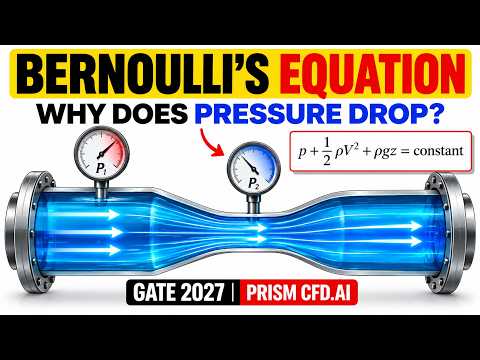 ▷
STAGE 01 · Fluid mechanics · Additional video
Fluid Mechanics: Bernoulli’s Equation & Venturi Meter Explained
Watch on YouTube ↗ ▷
STAGE 01 · GATE 2027 · Thermodynamics
Lec 02 · Thermodynamic Properties, State, Path & Equilibrium | GATE 2027
Watch on YouTube ↗ ▷
STAGE 01 · GATE 2027 · Thermodynamics
Lec 03 · Zeroth Law of Thermodynamics, Temperature Scales & Thermometry | GATE 2027
Watch on YouTube ↗ ▷
STAGE 01 · GATE 2027 · Thermodynamics
Lec 04 · Pressure Measurement, Quasi-Static Process & P–V Diagrams | GATE 2027
Watch on YouTube ↗ ▷
STAGE 01 · GATE 2027 · Thermodynamics
Lec 05 · Pure Substances & Phase Change | GATE 2027 Thermodynamics
Watch on YouTube ↗ ▷
STAGE 01 · GATE 2027 · Thermodynamics
Lec 06 · Steam Tables, P–v, T–v & P–T Diagrams | GATE 2027 Thermodynamics
Watch on YouTube ↗ ▷
STAGE 01 · GATE 2027 · Thermodynamics
Lec 07 · Thermodynamics Fundamentals, Formula Revision & PYQs | Mechanical + Aerospace
Watch on YouTube ↗ ▷
STAGE 01 · GATE 2027 · Thermodynamics
Lec 08 · Heat, Work & Sign Convention | GATE 2027 Thermodynamics
Watch on YouTube ↗ ▷
STAGE 01 · GATE 2027 · Thermodynamics
Lec 09 · Boundary Work: Isobaric, Isochoric & Isothermal Processes | GATE 2027
Watch on YouTube ↗ ▷
STAGE 01 · GATE 2027 · Thermodynamics
Lec 10 · Polytropic Processes & Reversible Adiabatic Work | GATE 2027 Thermodynamics
Watch on YouTube ↗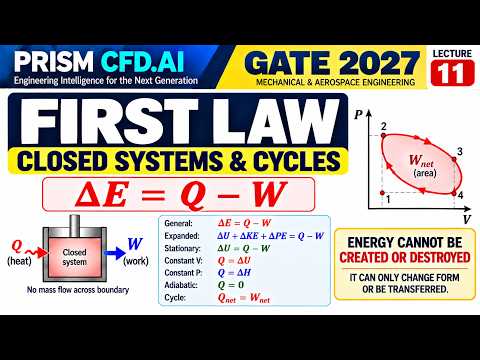 ▷
STAGE 01 · GATE 2027 · Thermodynamics
Lec 11 · First Law of Thermodynamics | Closed Systems & Cycles | GATE 2027
Watch on YouTube ↗Ready to apply the fundamentals?
Continue to Stage 2: Engineering analysis →Career ladder / Video resources
Build your skills with video lessons.
18 videos
Inside Advanced Engineering Explained
Five ideas. A deeper understanding.
 ▷
STAGE 03 · Fluid–structure interaction
Why Can Flow Make a Structure Vibrate? Vortex Shedding & VIV Explained
Watch on YouTube ↗ ▷
STAGE 03 · Turbulence & CFD
Why Turbulence Is Still Unsolved | RANS vs LES vs DNS Explained | CFD Fundamentals
Watch on YouTube ↗ ▷
STAGES 04–06 · Digital twins & engineering AI
What Is a Digital Twin? How CFD, AI & PINNs Fit Together
Watch on YouTube ↗ ▷
STAGE 05 · Aerodynamics
Understanding Aerodynamic Lift: How Wings Really Work
Watch on YouTube ↗ ▷
STAGE 05 · Compressible flow · Shock waves
What Is a Shock Wave? Normal Shocks, Oblique Shocks & Sonic Booms Explained
Watch on YouTube ↗Artificial Intelligence / Full Course
From Zero to Real Applications

Career ladder / Upcoming resources
Upcoming Playlists & Courses
Digital Twins & Automation: From Models to Smart Systems
Physics-Informed Neural Networks: From Fundamentals to Engineering Applications
Career ladder / Reading resources
Your engineering bookshelf.
Stages 1–2: fundamentals and analysis. Stage 3: CFD and multiphysics or advanced robotics. Stages 4–6: AI, aerospace, robotics, automation and physics-aware models. Stage 7: use these resources in your capstone.
STAGE 01 · FUNDAMENTALS
 Foundations
PRISM BOOK 01
Properties of Fluids
From First Principles to CFD
Fluid properties, viscosity, compressibility, cavitation and their meaning in CFD.
₹299Launch price
View book ↗STAGE 03 · SIMULATION
 Advanced CFD
PRISM BOOK 02
Turbulence Modeling Handbook
Module 7A
Build engineering judgement in turbulence model selection and y+ interpretation.
₹2,999Launch price
View book ↗STAGES 02–03 · CFD ORIENTATION
 Start here
PRISM BOOK 03
Introduction to CFD and Industry
A free engineering guide
Explore simulation fundamentals, industry applications, AI and digital twins.
FreeFree download
Get free guide ↗STAGE 04 · ENGINEERING AI
 Engineering AI
PRISM BOOK 04
AI in CFD 2026
Part 1 · Landscape & Technology Outlook
Understand the technologies shaping AI-driven simulation engineering.
₹499Launch price
View book ↗STAGE 04 · ENGINEERING AI
 Engineering AI
PRISM BOOK 05
AI in CFD 2026
Part 2 · Models & Industrial Deployment
Follow practical CFD-to-AI workflows from data generation to deployment.
₹799Launch price
View book ↗STAGE 04 · ENGINEERING AI
 Engineering AI
PRISM BOOK 06
AI in CFD 2026
Part 3 · PINNs & Neural Operators
Explore physics-informed models and next-generation simulation methods.
₹999Launch price
View book ↗No books match your search. Try another topic or select All books.
Every stage / Learn · Practice · Demonstrate
Turn learning into evidence of skill.
For every stage: watch a concept, read for depth, then demonstrate what you learned in a calculation or project.
01
Watch to understand
Use visual explanations to build intuition around a concept.
02
Read to go deeper
Explore the relevant book for theory, engineering interpretation and worked examples.
03
Practice to make it yours
Work through problems, check assumptions and explain the result in your own words.
Stage-by-stage resource directory
Resources for your next stage.
STAGE 02
Engineering analysis
Your evidence of skill
Next: Stage 3 — CFD & multiphysics or advanced robotics →Create a calculation notebook with assumptions, unit checks and a performance calculation.
Suggested practice taskSTAGE 03
CFD & multiphysics or advanced robotics
Your learning resourcesStart with the free CFD guide ↗Explore turbulence & CFD ↗Watch engineering explainers ↗
Your evidence of skill
Next: Stage 4 — AI & digital engineering →Document a verified CFD case, or a robotics project with sensing, control and testing evidence.
Suggested practice taskSTAGE 04
AI & digital engineering
Your learning resourcesBegin the AI course ↗Explore AI in CFD ↗See planned digital engineering resources ↗
Your evidence of skill
Next: Stage 5 — Specialization — Aerospace / Robotics / Automation →Build a small prediction or automation example and evaluate its errors and limitations.
Suggested practice taskSTAGE 05
Specialization — Aerospace / Robotics / Automation
Your learning resourcesExplore aerodynamics & shock waves ↗Watch aerospace and engineering explainers ↗See upcoming case studies ↗
Your evidence of skill
Next: Stage 6 — Next Gen Engineer →Develop an aerospace case study, robotics task or automation workflow with assumptions, validation and performance analysis.
Suggested practice taskSTAGE 06
Next Gen Engineer
Your learning resourcesExplore PINNs & neural operators ↗Build on AI in CFD ↗See planned digital twin & AI resources ↗
Your evidence of skill
Next: Stage 7 — Capstone Projects & Leadership →Prototype a thermal or fluid-system twin using simulated or measured data. Evaluate a PINN or surrogate against a conventional baseline and document errors and limitations.
Suggested advanced project · Digital twin resources plannedSTAGE 07
Capstone Projects & Leadership
Your learning resourcesChoose a technical foundation ↗Follow the learning and practice method ↗Explore planned capstone & portfolio resources ↗
Your evidence of skill
Return to your career ladder →A working engineering model and automated workflow, supported by a project plan, validation evidence, risk log, demonstration and technical handover.
Suggested capstone · Guided project resources plannedThe purpose behind every stage
Why PRISM Exists
PRISM was built to fix a gap that almost every engineer runs into.
- 01 · The gap
Graduates learn theory
Engineering degrees teach equations and concepts — but rarely the practical, tool-level skills industry actually runs on.
- 02 · The expectation
Industry expects practical skills
Employers want engineers who can mesh, solve, validate, automate and ship results from day one — not just pass exams.
- 03 · The guidance gap
Structured career guidance is often hard to find
Engineering teams move fast, and learning is frequently shaped by project priorities and delivery timelines. While knowledge is widely available, many aspiring engineers struggle to find a clear, structured pathway that connects skills, projects and career progression.
- 04 · The confusion
Engineers lack a clear roadmap
There’s no obvious path from “I know some CFD” to a defined, future-proof engineering role. People drift instead of progressing.
- 05 · The shift
Simulation is evolving — fast
The field is moving toward automation, AI, digital twins and autonomous engineering. Standing still means falling behind.
- 06 · The answer
PRISM was created to bridge that gap
A founder-led learning and insights platform that gives engineers direction, practical skills, portfolio clarity and a realistic roadmap — from CFD foundations toward the future of engineering.
The PRISM Ecosystem
How engineers grow with PRISM
The same seven-stage pathway, supported by current resources, planned content and practical evidence of skill.
Mechanical, aerospace, robotics & automation fundamentals
Build physics and mathematics through GATE Thermodynamics and fluid mechanics. Explore Stage 1 ↗
Engineering analysis
Translate physical questions into numerical calculations and reproducible engineering models. Explore Stage 2 ↗
CFD & multiphysics or advanced robotics
Choose simulation models, verify convergence and evaluate results against reference data. Explore Stage 3 ↗
AI & digital engineering
Prepare engineering data, evaluate AI models and automate repeatable analysis. Explore Stage 4 ↗
Specialization — Aerospace / Robotics / Automation
Apply compressible flow and aero-thermal fundamentals to generic aerospace problems. Explore Stage 5 ↗
Next Gen Engineer
Connect digital twins, PINNs and neural operators with physics, data and uncertainty assessment. Explore Stage 6 ↗
Capstone Projects & Leadership
Integrate your skills into a validated model and automation project, then demonstrate delivery and technical leadership. Explore Stage 7 ↗
Coming Soon!
What we’re building next.
Planned additions to the seven-stage pathway. Current resources remain available through the stage links above.
01Coming Soon!
Industry Case Studies
ALL STAGES · PLANNED
Real simulation decisions.
02Coming Soon!
Solver-to-AI Workflow
STAGE 04 · PLANNED
CFD, automation and models.
03Coming Soon!
Portfolio Execution
ALL STAGES · PLANNED
Projects you can showcase.
04Coming Soon!
Engineer Network
ALL STAGES · PLANNED
Learn with domain peers.
05Coming Soon!
CFD Foundations
STAGE 03 · PLANNED
Physics • Meshing • Solvers
06Coming Soon!
Automation Scripts
STAGE 04 · PLANNED
Python • Pipelines • Reports
07Coming Soon!
AI Simulation Models
STAGE 04 · PLANNED
PINNs • Surrogates • Twins
08Coming Soon!
Career Assets
ALL STAGES · PLANNED
Guides • Projects • Roadmaps
Guidance across the career ladder
PRISM CFD.AI
From Fundamentals to Specialized Engineering Expertise
Ex-GE Aerospace Lead Engineer
CFD • Multiphysics • Simulation
M.Tech Robotics & Automation
Robots • Embedded • Controls
Industrial Automation Lead
PLC • SCADA • Pneumatics
GE EEDP Leadership Graduate
Leadership • Innovation
GATE Scholar
National-Level Merit
Award-Winning Innovator
Multiple GE Hackathon Wins
IP Analyst
Patents • Technology
Ex Faculty, Mechanical Engineering
Teaching • Mentorship
AI Simulation & HPC
PINNs • Digital Twins
Multiple Journal Publications
Research • Engineering
11 Impact Awards
Recognition • Professional Excellence
NMEICT Certified
Fluid Mechanics
NSDC Certified
PLC • SCADA
Connect with Nandini Kaushik on LinkedIn ↗
Aerospace • Robotics • Industrial Automation • IP • Teaching • AI • HPC • Digital Twins
Keep moving up the ladder
Your next engineering skill starts here.
Choose your next stage today, or register for updates on new PRISM learning resources.
Navigating your career ladder
A few useful answers.
Where do I access the books?
Each book button opens its existing Topmate listing. Review the listing for the current price, format and access details before purchasing.
Where should I start?
Begin at Stage 1 with GATE Thermodynamics and fluid mechanics. If you already know the fundamentals, choose your next stage from the career ladder. Each stage links to relevant resources and a suggested practice outcome.
Are the lectures and books separate resources?
Yes. YouTube lectures are available to watch on YouTube, while the guides and handbooks are accessed through their individual Topmate listings.